
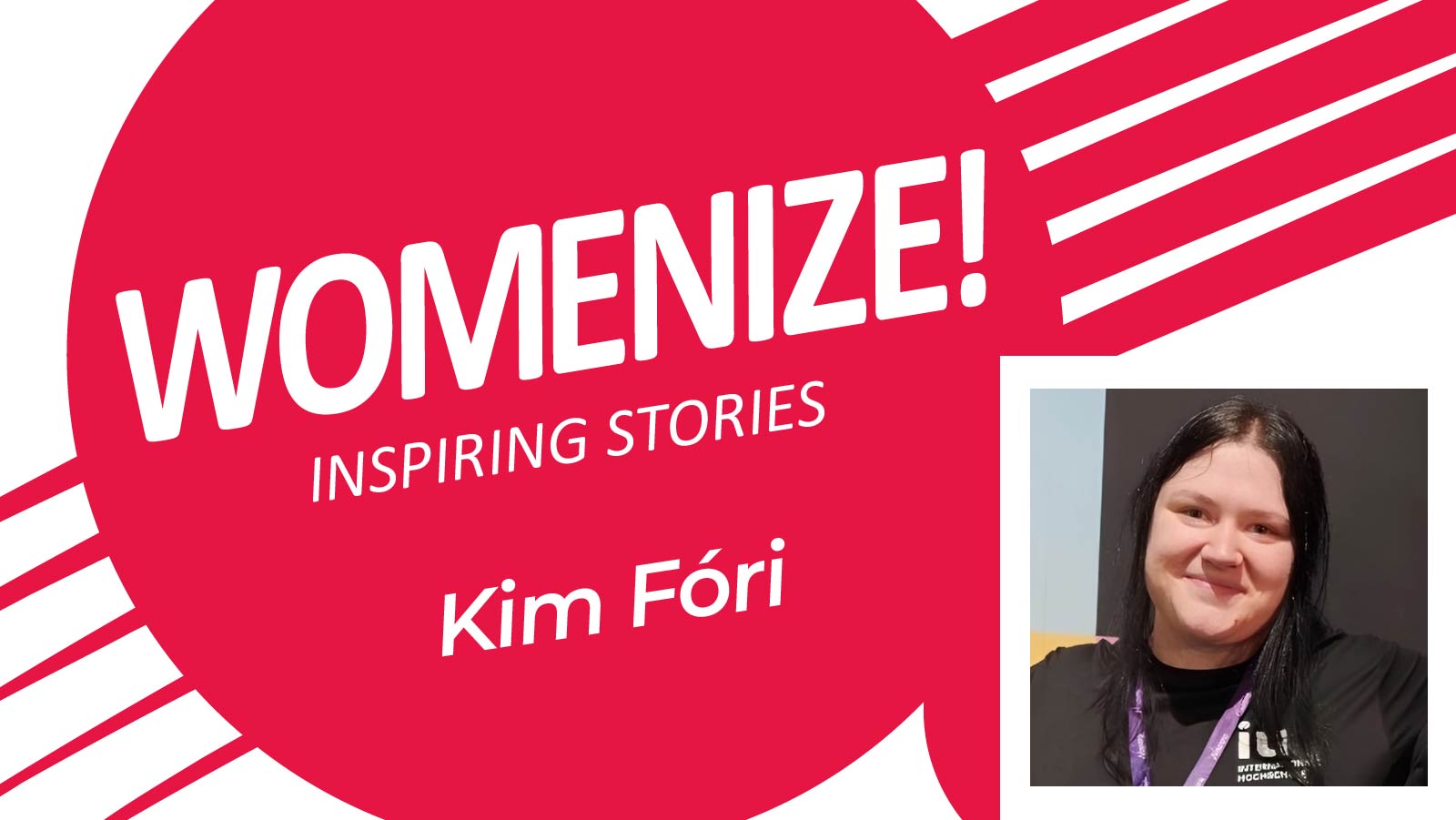
Game designer Kim Fóri reflects on her journey as an aspiring game developer, discussing how creativity, hands-on experience, and community have shaped her passion for game design. She also explores diversity and inclusion in gaming and shares advice for those seeking to find their place in the industry.
Every creative journey starts somewhere, and yours is already taking shape through your Game Design studies, personal projects, game jams, and exhibitions. What initially inspired you to pursue game design, and how have these early experiences shaped your creative identity and the kind of games you want to bring into life?
Games have honestly been part of my life for a really long time. I grew up playing them and I was always fascinated by them, but for quite a while I didn’t really think about making games as an actual career. I just knew that I loved games and that I was a creative person.
At some point, I started thinking more about what actually goes into a game. Why does a certain mechanic feel good? Why do I remember one character for years while completely forgetting another? Why can a tiny indie game stay in my head longer than a huge production?
That was probably when playing games slowly turned into wanting to make them myself.
Studying Game Design gave me the chance to actually try all of that out. And I think one of the most important things I learned during my studies was that Game Design is much broader than I originally thought. I got to work with mechanics, concepts, level design, writing, art, prototyping and development, and I noticed pretty quickly that I don’t really enjoy staying in just one of those areas.
I’m a Game Designer, but I’m also a Pixel Artist and an Indie Developer. I like being able to jump between those roles. Sometimes an idea starts with a mechanic, sometimes it’s literally just a tiny pixel character I drew and suddenly I want to know what kind of world this character lives in.
My own projects probably taught me the most about that. With “Candy Crisis“, for example, I did everything myself. That obviously meant a lot of work, but it also meant that I could experience the whole process. You very quickly notice that having a cool idea is the easy part. Turning that idea into something another person can actually play is a completely different thing.
Game jams were another big part of learning that. They are chaotic. You have way too many ideas, way too little time and at some point you have to accept that the version in your head is not going to be the version you finish. And weirdly, I think that’s really valuable. I’m someone who can spend way too much time thinking about details. A game jam doesn’t really allow that. You have to make decisions, throw things away, improvise and, most importantly, actually finish something. Even if it isn’t perfect.
Showing my work publicly was another step.
The first time someone plays something you’ve made while you’re standing there watching them is honestly a little terrifying. Suddenly you notice things you never noticed while developing it. Someone doesn’t understand something you thought was completely obvious. Someone finds a mechanic funny that you weren’t even sure would work. Or they do something you absolutely did not expect them to do.
But that’s also one of my favourite things about making games now. Games only really become games once someone interacts with them.
All of those experiences have also helped me figure out what kind of developer I want to be. I love colourful games, pixel art, cute things and slightly weird ideas. I don’t think everything I create needs to be huge or serious. Sometimes I just want to make something that makes someone smile.
At the same time, I’ve become much more interested in the people behind and in front of games. Who makes them? Who plays them? Who feels represented in them? Who feels welcome in gaming spaces?
So I think my creative identity is still developing – and I actually like that. I don’t want to decide that I am only allowed to make one specific type of game for the rest of my career. I want to experiment, try things, fail at things and hopefully keep making games that feel like they have a little bit of me in them.
Beyond creating games, you’ve also engaged in conversations about diversity in the industry and gained experience working with young people through your voluntary service. How have these experiences influenced your perspective on the social impact of games, and what role do you believe game designers can play in creating more inclusive and meaningful experiences?
I think my perspective on this has changed quite a lot over the last few years. When you’re younger and you’re playing games, you don’t necessarily analyse the spaces around them. You’re just playing. But once you spend more time in gaming communities – especially online – you start noticing things.
And as a woman in gaming, there are definitely things that are difficult not to notice.
There is still this idea that gaming is completely equal now and that sexism isn’t really an issue anymore. But then you go into certain online spaces, use voice chat, look at comment sections or listen to how people talk about women in games and you realise pretty quickly that it’s more complicated than that.
That topic eventually became a really big part of my Bachelor’s thesis. I researched the boundary between trash talk and sexism in the voice chat of competitive online games. What interested me wasn’t simply whether toxic behaviour exists – we already know that it does. I was much more interested in the point where people stop seeing something as normal competitive trash talk and start seeing it as sexist.
Because I think that boundary says a lot about gaming culture.
There are things people hear so often that they almost stop noticing them. Something gets dismissed as a joke or as “normal gaming behaviour”, and if someone says they’re uncomfortable with it, the response can quickly become: “It’s not that serious.”
But maybe we should ask why certain behaviour became normal in the first place. That doesn’t mean I think trash talk itself has to disappear. I play competitive games too. I know that people get frustrated, tease each other and say stupid things in the heat of a match. That’s part of the social side of gaming as well.
For me, the interesting question is where that changes. When is it no longer about the game or the situation and instead about someone’s gender, identity or simply making that person feel like they don’t belong there?
Working with young people during my voluntary service gave me another perspective on that.
When you work with younger people, you realise very quickly how important digital spaces have become. Games aren’t this separate little hobby that happens after “real life”. For a lot of people, games are where they spend time with friends, where they meet new people and where they are part of a community. That means those spaces matter. And I think game designers have more influence over them than we sometimes realise.
Obviously, a designer can’t control everything players say or do. And I also don’t think every game needs to become an educational project. Sometimes a game can just be about a frog doing something stupid and that’s completely fine. Actually, I think we need those games too. But there are still decisions we make as designers that shape the experience.
How do players communicate with each other? What behaviour does the game reward? What tools do players have when someone crosses a line? How are characters written and designed? Who gets to be the hero? Who is always the joke? Can different people recognise themselves somewhere in the game without their identity becoming their entire personality? Even small decisions can make a difference.
Diversity also shouldn’t feel like a checklist.
I don’t want to put a character into a game just so I can say, “Look, my game is diverse.” That’s not meaningful representation. For me, it’s much more about being aware that the people playing our games are different. They have different experiences, backgrounds and perspectives, and that’s actually something that can make games more interesting rather than limiting them.
I also think we need more different voices on the development side of the industry. If the same types of people are always making the decisions, we’re naturally going to keep seeing some of the same perspectives. So for me, inclusion in games isn’t just about what happens on the screen. It’s also about who gets to create those games in the first place.
Breaking into the games industry can feel intimidating, especially when you’re still studying or finding your creative voice. Looking at your own journey so far, what have been your most valuable lessons, and what advice would you give to other aspiring game developers who want to start creating, sharing their work, and finding their place in the industry?
I actually really like this question because I’m currently right in the middle of this myself. I’ve finished my Game Design degree now, which still feels a little strange to say after spending so much time working towards it, and I’m currently trying to find my first proper place in the games industry. And yes – it is intimidating. I think when you study Game Design, there’s sometimes this idea in your head that you’ll finish your degree, have a portfolio and then you’ll apply somewhere and that’s it.
Reality is a little different.
The games industry is difficult to enter, and there are a lot of incredibly talented people looking for jobs. It’s very easy to look at someone else’s portfolio or LinkedIn and think: “Okay, they can do all of that. What am I even doing here?” I’ve definitely had those moments. One of the biggest things I’m learning is not to compare the beginning of my career to someone else’s middle. Someone who has worked in the industry for ten years obviously has a different portfolio than I do. That doesn’t mean I’m not good enough to start. It just means I’m starting.
Another lesson has been how important it is to actually show your work. That sounds incredibly obvious, but it wasn’t obvious to me for a long time. I used to think something had to be really polished before I could show it. Now I’m much more comfortable sharing work in progress, sketches, pixel art, prototypes and even things I’m still experimenting with.
I’ve been doing that a lot more recently, and it has helped me stop treating everything I create like it has to prove whether I’m a “good developer” or not. Sometimes I’m just trying something. Sometimes it works. Sometimes it absolutely doesn’t. And that’s fine.
Events have also been really important for me.
Going to places like gamescom, showing projects, meeting developers and simply talking to people made the industry feel much more real. Online, you mostly see job titles, studio names and finished games. At an event, you realise that behind all of that are just people who also started somewhere.
I also learned that networking doesn’t have to mean walking up to someone and basically saying, “Hello, please give me a job.”
That was honestly something I used to find really uncomfortable about the whole idea of networking. For me, it’s much easier to think of it as meeting people who like the same weird industry I do. You talk about games, projects, problems you’re having, things you’re excited about – and sometimes opportunities grow out of those conversations naturally.
Another big lesson for me was saying yes to things that scared me a little.
Speaking publicly was one of those things. If someone had told me a few years ago that I would stand in front of people and talk about topics in gaming, or be part of discussions and podcasts, I’m not sure I would have believed them. But every time I’ve done something like that, the next time became slightly less scary.
And I think that’s probably the advice I would give someone who is just starting: Make things before you feel ready.
You don’t need to wait until university teaches you everything. You don’t need to wait until you know Unity perfectly. You don’t need to wait until your art looks like the art of someone who has been doing it professionally for fifteen years.
Make a tiny game. Make a terrible game. Join a game jam. Draw the character. Write the story. Put something on itch.io. And most importantly: finish things.
I have folders full of ideas. Ideas are very easy to have. Finishing them is the difficult part. A finished tiny game will teach you so much more than the giant dream game you’ve been planning for three years but never actually started.
I’d also tell people to share their work. I know that can be scary because the internet isn’t exactly famous for always being kind. But sharing my work has opened doors for me that keeping everything on my computer never could have. And don’t assume that everyone else has everything figured out. Because they really don’t. I’m still figuring things out too.
I know that I want to work in games. I know that I love Game Design, pixel art and creating my own projects. I know that I want to keep learning and hopefully find a team where I can contribute creatively and grow. But I can’t tell you exactly what my career will look like five years from now. And I’m actually okay with that.
If there’s one thing I’ve learned so far, it’s that you don’t find your place in the games industry by sitting somewhere and waiting until you suddenly feel ready for it.
You make things. You show up. You talk to people. You try something new. You get rejected sometimes. You try again. And somewhere in between all of that, you slowly start finding out where you belong.
Thank you for this interview, Kim!
Follow Kim Fóri here:

