
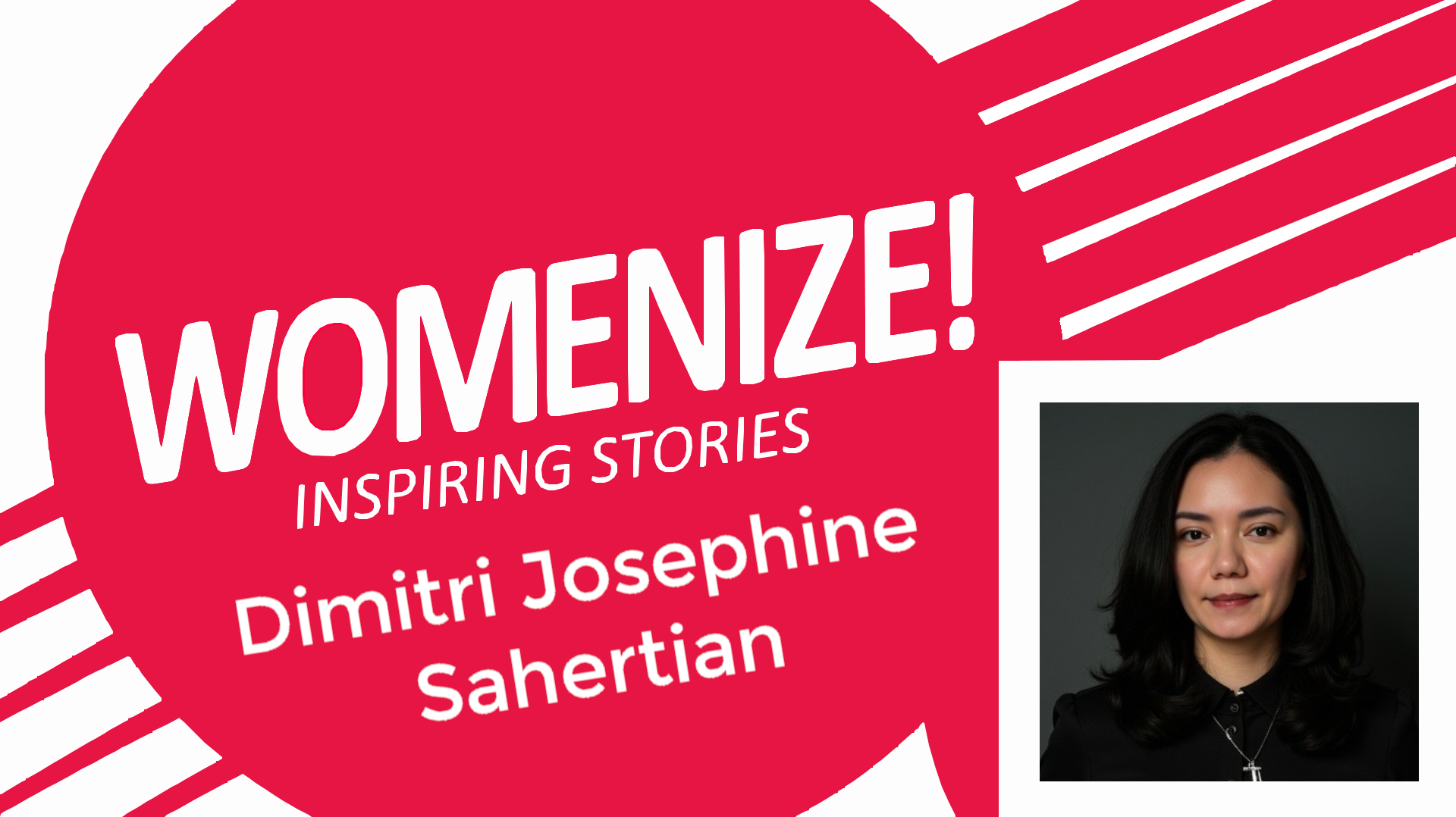
Dimitri Josephine Sahertian, Virtual Production & Real-Time Technology Specialist, went from experimenting with virtual production at home with no technical background to helping build Indonesia’s first virtual production studio. She believes that taking opportunities before you feel ready can open doors you never imagined.
Hi Dimitri! Your path into virtual production was anything but conventional: you came from a business background and entered the field without formal training in filmmaking, game development, computer graphics or engineering. When there was no obvious roadmap to follow, how did you figure out what to learn, where to begin, and when did you first realise, “I actually belong in this field”?
My entry into virtual production was really from zero. I didn’t join an established virtual production studio and learn the technology from there. I was literally building the industry and ecosystem in Southeast Asia, particularly in Indonesia, where I come from. At the time, there wasn’t really a studio or established pathway for me to follow because the industry wasn’t even there yet.
My background was in Business, specifically Marketing and Human Resource Management, although now I’m currently doing a PhD in Creative Technology. However, I had no formal training in filmmaking, game development, computer graphics or engineering. I first became interested in real-time technology and Unreal Engine simply because I could see its potential, but I didn’t initially know exactly where it would take me.
I started exploring it at home with my husband during the pandemic. We had very limited hardware, so a lot of the early experimentation was literally just us trying things out at home and figuring out what the technology could actually do.
Then we started talking to people in the industry about the potential of this technology and pitching the idea of using it for filmmaking before I had actually done a full production with it. In a way, I was selling the possibility before I had completely figured out how to deliver it. Whenever someone became interested enough to actually try shooting with the technology, that became my learning opportunity. A project would come in, and I would go back and figure out how to make it work. I learned through every project: what hardware we needed, how to build the workflow, how to solve technical problems, how to work with cameras and tracking, how to integrate motion capture, and eventually how all of these components needed to work together as a production pipeline.
So there was no point where I thought, “Okay, now I’m ready to start.” I started first, and then I had to become ready along the way.
That process was challenging, but it was also what allowed me to understand virtual production from the ground up. I wasn’t learning one particular role within an existing pipeline; I had to understand how the entire ecosystem worked because I was helping build it.
About two years after those early experiments at home and a few projects to work on, we were getting more in demand, and that’s when we were able to build what became the first virtual production studio in Indonesia. Looking back, that is probably the moment when I realised just how far we had come. We had started with very limited resources, experimenting at home, and eventually created an actual production environment around a technology that was still very new in our market.
So when you ask when I first realised, “I actually belong in this field,” I think it happened through doing rather than through recognition or qualifications. Every time I encountered something I didn’t know, I figured it out because I had to. Eventually, I stopped seeing myself as someone trying to enter the field and started seeing myself as someone who could actually shape the field.
You’ve gone from teaching yourself an emerging technology to becoming Indonesia’s first female Unreal Engine Authorized Instructor, while also mentoring and advocating for women internationally. How has supporting and creating opportunities for others shaped your own journey, and what does it mean to you to help make these pathways more accessible for the women coming after you?
Supporting others has become an important part of my journey because I know how meaningful it can be to see someone like you represented in an industry.
As a woman working in a male-dominated field, I want other women to know that they shouldn’t underestimate themselves simply because they are in the minority. If you can contribute, solve problems and create meaningful work in that space, then you have every right to be there. Your skills and knowledge are just as valuable as anyone else’s.
Becoming the first female Unreal Engine Authorised Instructor in Indonesia and Southeast Asia was meaningful to me not only because of the achievement itself, but because it made that possibility more visible. If another woman sees my journey and thinks, “Maybe I can do this too,” then that already means a lot to me.
Through mentoring and community building, I hope I can give people not only technical knowledge, but also the confidence to take themselves seriously and pursue opportunities they might otherwise think are not for them.
Ultimately, I want to help create an industry where women don’t feel that they have to prove that they belong simply because they are women.
Your career keeps challenging the idea that there is one “right” qualification or route into creative technology from entering virtual production as a self-taught newcomer to beginning a fully funded PhD without first completing a Master’s degree. For someone who sees an opportunity but thinks, “I don’t have the right background for this,” what would you want them to know from your experience?
I would tell them not to confuse “I don’t have the traditional background” with “I’m not capable of doing this.”
My career has repeatedly shown me that there are many different ways to arrive at the same destination. I entered virtual production from a business background and taught myself the technology from zero, but became the first Unreal Engine Authorised Instructor. I am now undertaking a fully funded PhD without having completed a Master’s degree. In fact, I was approached by the university and my supervisor because they saw potential in my professional experience and research.
More recently, I was selected as a finalist for the Women in Technology Awards in Queensland. That was particularly meaningful to me because I’m not originally from Queensland. I returned to Brisbane just 6 months ago, and my background is in creative technology rather than a traditional STEM field. I was entering a space where my profile was not necessarily the conventional one, alongside many incredible finalists with strong STEM backgrounds, PhDs and significant contributions to Queensland’s technology sector.
I’ve also been approached to teach at my university, despite not having a Master’s degree or a formal teaching background. These experiences have continued to challenge my own understanding of what we are “supposed” to have before we can take on a particular opportunity. Of course, qualifications are valuable. But they are not the only way to demonstrate capability. Professional experience, curiosity, practical knowledge, persistence and the willingness to keep learning can also open doors.
So if someone sees an opportunity but thinks, “I don’t have the right background,” I would say: don’t let the pathway you haven’t taken convince you that you are incapable of reaching the destination. Your pathway doesn’t have to look like everyone else’s. Sometimes you have to be willing to take the opportunity before you feel completely ready, prove what you can do, and let your work speak for itself. And I think my own journey is a reminder that there isn’t always one “right” qualification or route into creative technology. Sometimes the unconventional path can take you further than you imagined.
Thanks for this interview, Dimitri!
Dimitri’s links: LinkedIn
Womenize! – Inspiring Stories Feature by Madeleine Egger

