
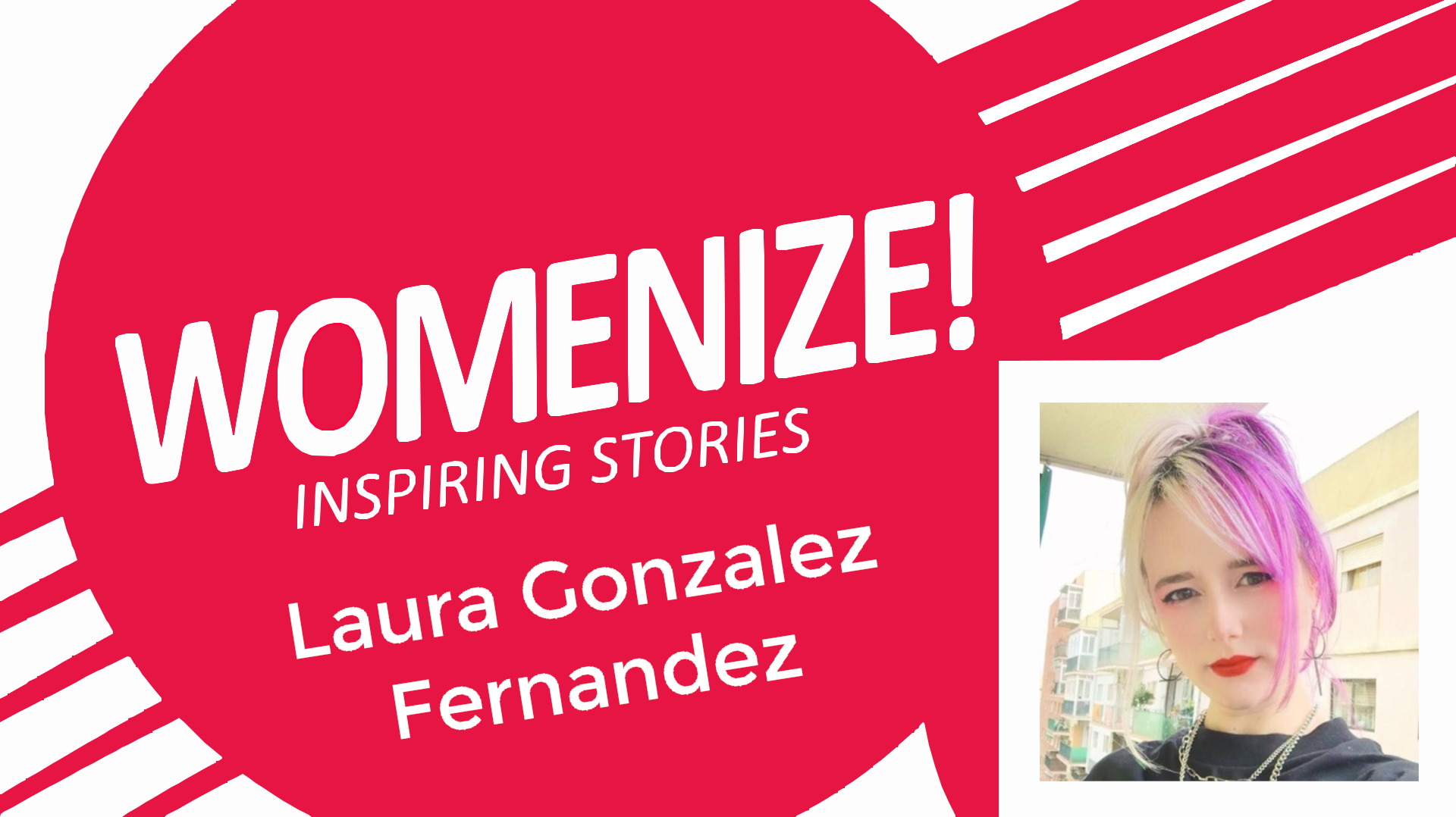
Laura Gonzalez Fernandez – Womenize! – Inspiring Stories
Womenize! – Inspiring Stories is our weekly series featuring inspirational individuals from games and tech. For this edition we talked to Laura Gonzalez Fernandez, Director at PowerUp+ & Co-Director at IndieDevDay. She speaks how curiosity took her from coding in BASIC as a child to building a career in games and why creating opportunities, inclusive spaces, and a sense of belonging for others has become her greatest passion. Read more about Laura here:
Hi Laura! From writing your first programs in BASIC on a toy computer in the 90s to becoming a leader in the videogame ecosystem through PowerUp+ and IndieDevDay, your journey has evolved alongside technology itself. What were the key moments, people, or decisions that shaped your path from being curious about code to creating opportunities for others in the industry?
I’m a naturally curious person. As a child, I was fascinated by understanding how things worked, to the point that many of my mechanical toys ended up disassembled because I wanted to discover what was inside them and why they moved.
That’s why, when that little toy computer came into my hands, I wasn’t even aware that I was programming in BASIC. All I knew was that I could create things from an idea. I would write a few instructions, and the computer would do exactly what I asked. That was the moment when the seed of what would eventually become a large part of my professional career was planted.
Over the years, I worked in different areas of software development and gradually discovered that technology is not just a tool. It is also a way to connect people, solve problems, and create opportunities.
I’ve been playing video games since the 1990s, when I first got my hands on a Game Boy with Tetris, but for a long time I never considered working in the games industry. I think what I call the “democratization of game development engines” was one of the factors that encouraged me to make the leap from traditional software development into game development. But, if I’m honest, it all started with a much simpler question: “I’d love to create my own stories. What if I made video games?”
That question led me into a new quest. I found an incredibly passionate, creative, and generous community, but I also saw firsthand the challenges many people faced when trying to enter the industry or simply bring their projects to life. I was also fortunate not to walk that path alone. People like Rocío Tomé from Patattie Games and Mariona Valls from Mango Protocol helped me tremendously in my early days, sharing advice, knowledge, and experience exactly when I needed it most.
Amid all that whirlwind of change, IndieDevDay was born, one of those turning points in life that you don’t fully recognize until much later. It began as a community-driven initiative and, over time, grew into a meeting point for studios, professionals, students, and companies from all over the world. Seeing how a project that started so organically could have such a meaningful impact on so many people made me realize that I wanted to dedicate part of my career to building ecosystems and creating opportunities for others.
Later came other projects, such as PowerUp+, Spain’s first game incubator with a gender perspective. Through it, we have worked to make the industry more accessible to people from underrepresented groups and to support teams with extraordinary ideas who often lacked the resources needed to turn them into reality. Being able to accompany them through those first steps has been one of the most rewarding experiences of my career.
More recently, I brought another seemingly crazy idea to life: BCN Game Gallery, a multidisciplinary space dedicated to video games that aims to bring gaming closer to the cultural sphere and spark new conversations around the medium.
Looking back, I realize that I never really had a roadmap. I simply followed what genuinely excited me and what sparked my curiosity. I’ve been lucky enough to be surrounded by people who shared their knowledge, time, and trust with me, and who made me feel that I belonged to a community. Today, I try to give some of that support back by creating spaces where others can grow, learn, and develop their talent.
Because, in the end, if there’s one thing that has truly shaped my journey, it hasn’t been technology itself, but the people I’ve met through it. And perhaps that’s why my greatest satisfaction today is no longer creating projects myself, but helping others create theirs.
You have built a career across different areas of technology, from legacy systems and clean code to full-stack development and now game development, community building, and inclusion initiatives. What have these different chapters taught you about adapting, reinventing yourself, and finding your place in a constantly changing tech landscape?
If technology and life have taught me anything, it is that reinventing yourself is not the exception, but the norm. I began my professional journey in tech working with hardware, repairing equipment in technical support. Later, I moved through very different environments, but many of them had one thing in common: legacy systems and projects with years of history behind them. It was there that I learned that sustainability, stability, and code quality are just as important as innovation when building software.
Each of those stages gave me a different perspective. Legacy systems taught me patience, responsibility, and respect for the work of those who came before us. Full-stack development taught me to understand projects from a holistic perspective, seeing how all the pieces fit together to create a complete solution. Game development reminded me of the importance of creativity, experimentation, and multidisciplinary collaboration. And community building taught me something even more valuable: that people are always at the heart of every successful project.
For a long time, I believed that a professional career meant choosing a single path and following it for years. Today, I believe the opposite. The most rewarding careers are often built by exploring different disciplines, learning from diverse environments, and allowing ourselves to evolve alongside the industry.
Technology is constantly changing. Tools, programming languages, and trends come and go. Yet curiosity, the ability to learn, and the willingness to collaborate remain timeless skills. If there is one thing I have learned over the years, it is that you do not need a perfect career path or a perfectly defined plan. What matters is staying open to new opportunities and understanding that every experience, even those that seem unrelated to our ultimate goals, can provide valuable tools for the future.
Looking back, many of the things I do today, from driving initiatives like IndieDevDay and PowerUp+ to opening BCN Game Gallery, are the result of knowledge and lessons I gained during stages of my career that, at the time, seemed completely unrelated. And perhaps that is the most important lesson of all: you never know which skill, experience, or connection will help you build your next chapter.
A central part of your work today is opening doors for underrepresented communities and encouraging more women to pursue technical roles in videogames and ICT. What changes do you believe are needed to make the industry more inclusive, and what advice would you give to women who are passionate about technology but are still looking for the confidence or opportunity to take their first steps?
I believe that inclusion cannot be achieved simply by increasing the visibility of certain groups. Visibility is important, but on its own it is not enough. We also need to examine how people enter the industry, how we retain talent, and how we build environments where everyone has equal opportunities to grow, develop, and lead.
There are still structural barriers that disproportionately affect women and other underrepresented groups. Some are obvious, but many are far more subtle: the lack of role models, the feeling of not belonging, impostor syndrome, the absence of professional networks, or limited access to certain spaces and opportunities. More often than not, it is not a single barrier that holds people back, but the accumulation of many small obstacles over time.
That is why I believe initiatives such as mentoring programs, incubators, professional communities, and safe spaces are so important. It is not enough to tell someone that they can pursue a career in technology or game development; we also need to provide the tools, training, connections, and opportunities that make that path truly accessible. PowerUp+ was created with exactly that philosophy in mind: helping transform talent and ideas into real opportunities.
I also believe that the responsibility for change should not rest solely on those trying to enter the industry. Companies, institutions, events, and communities need to continuously ask themselves what barriers they may still be maintaining, even unintentionally, and what they can do to create more diverse, inclusive, and welcoming environments.
To women who are passionate about technology but still hesitate to take that first step, I would say something very simple: don’t wait until you feel 100% ready. Most of the people we admire started without having all the answers and learned along the way. Confidence often comes after taking action, not before.
Find communities, share your work, ask questions without fear, and surround yourself with people who encourage you to grow. You don’t need to know everything before you begin. In fact, one of the most valuable skills in technology is the ability to keep learning continuously.
The industry needs diverse perspectives, different experiences, and new voices. Not only because representation matters, but because technology and video games are better when they reflect the diversity of the people who create and use them.
And above all, remember that you do not have to fit a specific mold to belong in this industry. There is no single way to be a developer, designer, entrepreneur, or technology leader. There is room for many different profiles, career paths, and ways of thinking. In fact, I believe that diversity is one of our industry’s greatest strengths and one of the keys to continuing to innovate in the future.